
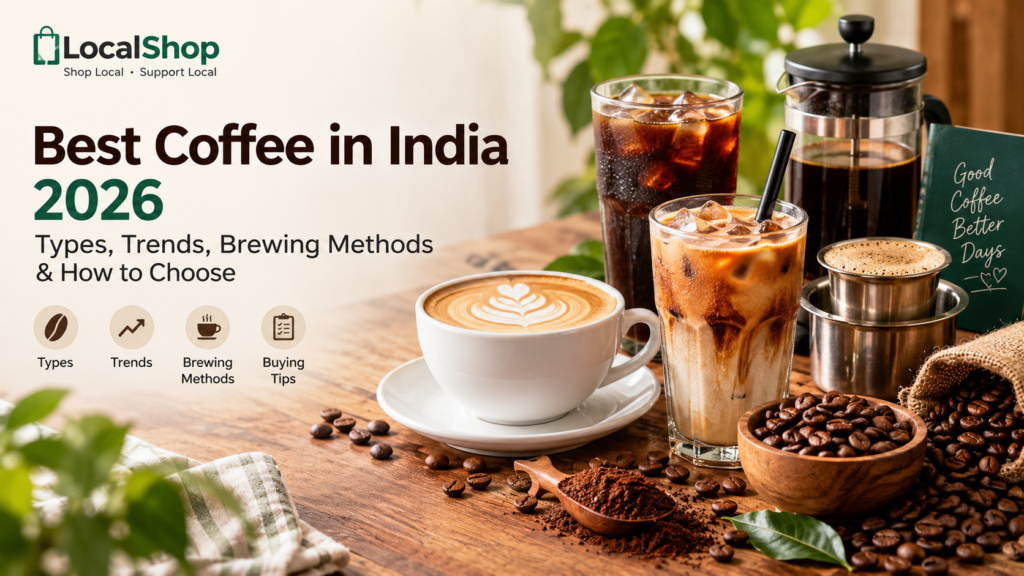




Coffee in India is no longer limited to a morning cup of instant coffee or traditional South Indian filter coffee. In 2026, coffee culture is becoming more diverse, with people exploring cold brew, iced coffee, specialty beans, single-origin coffee, espresso, pour-over brewing and convenient ready-to-drink formats.
For some people, coffee is still about a quick caffeine boost before work. For others, it is about flavour, brewing technique, café culture and discovering different coffee origins.
So, which is the best coffee in India?
The answer depends on what you want from your coffee.
If convenience matters most, instant coffee can be a practical choice. If you enjoy traditional flavours, South Indian filter coffee remains an important part of India’s coffee culture. If you want more control over flavour, freshly ground beans and specialty coffee offer a completely different experience. And if you prefer a refreshing drink, cold coffee and cold brew have become increasingly popular.
This guide explains the major types of coffee available in India, the coffee trends shaping 2026, different brewing methods, and how to choose the right coffee for your home.
India has a long relationship with coffee, particularly in southern states such as Karnataka, Kerala and Tamil Nadu. However, the way people consume coffee is changing.
Coffee consumption in India has increased over the past decade, with the Coffee Board of India and CRISIL reporting growth in domestic consumption alongside increasing café culture, younger consumers and interest in niche and specialty coffee.
The country’s coffee ecosystem is also supported by a strong domestic production base. Karnataka remains a major coffee-producing region, with important growing areas including Chikkamagaluru, Kodagu and Hassan.
At the same time, urban consumers are discovering new ways to drink coffee.
Today, someone might start the morning with instant coffee, order a latte while working, drink cold brew during the afternoon and experiment with a pour-over coffee on the weekend.
That variety is one of the biggest changes happening in India’s coffee culture.
Coffee trends are moving beyond simply choosing between tea and coffee. Consumers are increasingly interested in flavour, convenience, origin, brewing method and experience.
Here are some of the biggest coffee trends worth watching in 2026.
Cold coffee used to be strongly associated with hot weather and summer menus.
That is changing.
Recent reporting on India’s beverage market shows younger consumers increasingly choosing iced lattes, cold brews and packaged cold coffee. The category is also being supported by convenience and quick-commerce availability.
Cold coffee is popular because it combines caffeine with a refreshing drinking experience.
You can also customise it easily with:
For people who find hot black coffee too strong or bitter, cold coffee can be an easier entry point.
The terms cold brew and iced coffee are often used interchangeably, but they are not the same.
Iced coffee is generally hot-brewed coffee that is cooled and served over ice.
Cold brew is prepared by steeping coffee grounds in cold or room-temperature water for an extended period before filtering the mixture.
The result can be smoother and less sharp than traditionally brewed coffee, depending on the beans, grind size and brewing recipe.
Cold brew has become a major part of modern coffee culture because it works well as both a café drink and a convenient home beverage.
If you are searching for the best cold brew coffee, pay attention to the roast profile, freshness, brewing ratio and whether you prefer a stronger concentrate or a ready-to-drink version.
Specialty coffee focuses more attention on the coffee itself.
Instead of simply buying “coffee,” consumers may look at:
This has helped introduce more Indian consumers to concepts such as single-origin coffee and micro-lot coffee.
Specialty coffee is also closely connected with the growth of cafés and home brewing. Recent reporting on India’s coffee market highlights increasing consumer interest in brewing methods such as espresso, pour-over, AeroPress and cold brew.
For a beginner, however, specialty coffee does not have to mean expensive equipment.
You can start with freshly roasted ground coffee and a simple brewing method.
You no longer need to visit a café every time you want something different.
Many coffee drinkers are experimenting at home with:
The brewing method can dramatically change the final cup.
For example, a French press generally produces a fuller-bodied cup, while pour-over brewing can highlight delicate flavour characteristics.
This makes coffee more than a beverage—it becomes a small home ritual.
While specialty coffee is growing, traditional Indian coffee has not disappeared.
South Indian filter coffee remains one of the most recognisable coffee styles in the country.
A typical filter coffee uses finely ground coffee brewed through a metal filter and is traditionally served with hot milk and sugar.
For many households, the appeal isn’t just the caffeine. It is the aroma, preparation and familiarity.
Modern coffee culture is therefore not necessarily replacing traditional coffee.
Instead, both are existing side by side.
You can enjoy a traditional filter coffee in the morning and a cold brew later in the day.
One of the most common questions for home coffee drinkers is whether they should buy instant coffee or ground coffee.
The answer depends mainly on convenience and the type of coffee experience you want.
Instant coffee is made for convenience.
It is easy to prepare, requires almost no equipment and can be stored easily.
It works particularly well for:
Recent India-focused coffee consumption data also points to strong demand for soluble coffee, showing that instant coffee remains a major part of the Indian market.
Ground coffee gives you more control over brewing.
You can experiment with:
It generally requires more preparation than instant coffee, but it can provide a more customisable experience.
If you enjoy making coffee rather than simply drinking it, ground coffee can be worth exploring.
There is no single coffee that everyone will consider the best.
Instead, start by asking five questions.
If you need coffee in two minutes, instant coffee makes sense.
If you enjoy spending 5–10 minutes preparing a drink, consider ground coffee and a manual brewing method.
Milk-based coffee can work well with medium or darker roasts, while people who enjoy black coffee may want to explore lighter or medium roasts with more noticeable flavour characteristics.
However, taste is personal.
There is no universal rule saying that a particular roast must be consumed in a particular way.
Strength and roast level are not exactly the same thing.
A darker roast may taste more intense and roasted, while brewing parameters also influence the strength of the final drink.
Adjusting the coffee-to-water ratio is one of the easiest ways to change strength.
For hot coffee, explore filter coffee, French press, pour-over or espresso-based drinks.
For cold coffee, consider iced coffee or cold brew.
If you regularly drink cold coffee, choosing coffee that works well with milk and ice can make a noticeable difference.
This may be the most important question.
If convenience is your priority, choose an easy-to-prepare format.
If flavour exploration is your priority, start exploring fresh ground coffee, different origins and brewing techniques.
Here are some popular coffee styles worth exploring.
Espresso is a concentrated coffee brewed by forcing water through finely ground coffee under pressure.
It forms the base of drinks such as:
Cappuccino combines espresso, steamed milk and milk foam.
It is generally richer and foamier than a latte.
A latte contains espresso with a larger amount of steamed milk.
It is a popular choice for people who prefer a smoother, milkier coffee.
An Americano is made by combining espresso with hot water.
It provides a longer drink while retaining espresso’s characteristic flavour.
Mocha combines coffee with chocolate and milk.
It is particularly suitable for people who enjoy sweeter coffee drinks.
This traditional style combines strong brewed coffee decoction with hot milk and sugar.
It remains an important part of Indian coffee culture.
Cold brew is steeped in cold water for an extended period and then filtered.
It can be served over ice and diluted or mixed with milk.
One interesting development in today’s beverage culture is the move toward unusual flavour combinations.
Coffee is increasingly being paired with ingredients such as:
Recent International Coffee Day coverage in India highlighted combinations such as cinnamon-jaggery cold brew, cardamom cold brew and filter coffee-based desserts.
This is particularly interesting for home coffee drinkers because you don’t need expensive equipment to experiment.
Try adding a small amount of cinnamon or cardamom to your coffee and see how it changes the aroma.
You can also experiment with jaggery instead of refined sugar.
You do not necessarily need an expensive coffee machine to improve your coffee.
Start with the basics.
Coffee loses some of its aroma and flavour characteristics over time.
If possible, choose coffee with clear roast information and store it properly.
Coffee is mostly water, so water quality matters.
If your tap water has a strong taste or odour, filtered water can produce a cleaner cup.
Different brewing methods require different grind sizes.
For example:
Using the wrong grind can affect extraction and the final taste.
The amount of coffee relative to water has a major effect on strength.
Instead of randomly adding coffee powder, experiment with a consistent ratio and adjust it according to your taste.
Extremely hot water can make some coffees taste harsh, while water that is too cool can result in under-extraction.
Consistency is more important than chasing a perfect number.
If you are beginning to explore coffee beans, you will frequently see two names: Arabica and Robusta.
Arabica is often associated with more nuanced flavour profiles and acidity, while Robusta is generally known for stronger, more bitter characteristics and higher caffeine content.
India produces both Arabica and Robusta.
Coffee Board statistics show substantial production from regions across Karnataka and Kerala, with both varieties contributing to India’s coffee output.
Blends can combine characteristics from both varieties.
For example, a blend might provide the body and intensity associated with Robusta while retaining some of the flavour characteristics of Arabica.
Not necessarily.
A more expensive coffee may offer a different origin, processing method, roast profile or sourcing story, but price alone does not determine whether you will enjoy it.
The “best coffee” is ultimately the coffee that matches your taste, brewing method and budget.
For a beginner, it can actually be more useful to try a few different affordable coffees rather than immediately purchasing the most expensive option.
Compare:
Your own preferences will become much clearer.
Whether you are buying coffee online or from a local store, check the product information before purchasing.
Look for:
Roast information:
Fresh roast information can help you understand how recently the coffee was produced.
Bean type:
Check whether it is Arabica, Robusta or a blend.
Grind type:
Make sure the grind is suitable for your brewing method.
Origin:
Single-origin coffee can be interesting if you want to explore regional flavour differences.
Flavour profile:
Descriptions such as chocolate, caramel, nutty, fruity or spicy can help you choose something closer to your taste.
Pack size:
If you are trying a new coffee for the first time, consider starting with a smaller pack.
The biggest change may not be one particular drink.
It is the personalisation of coffee.
People are choosing coffee based on how they want to consume it at a particular moment.
A busy morning may call for instant coffee.
A relaxed weekend may call for pour-over.
A hot afternoon may call for cold brew.
A café visit may mean a latte or cappuccino.
A traditional breakfast may call for South Indian filter coffee.
This flexibility is helping coffee move from a single daily beverage into a broader lifestyle category.
So, what is the best coffee in India in 2026?
There is no single answer.
The best coffee depends on your taste, budget, brewing method and lifestyle.
If convenience matters most, explore instant coffee.
If you enjoy traditional Indian flavours, try South Indian filter coffee.
If you want to experiment, explore specialty coffee and single-origin beans.
If you prefer refreshing drinks, try cold coffee or cold brew.
And if you enjoy the process itself, start exploring home brewing methods such as French press, pour-over or AeroPress.
India’s coffee culture is becoming more diverse, and that gives coffee lovers more choices than ever before. From traditional filter coffee to modern cold brew and specialty beans, there is plenty to explore.
The easiest way to find your favourite is simple: try different coffees, experiment with brewing methods, and discover what works for you.
Whether you’re buying your first pack of coffee or looking for something new to add to your kitchen shelf, Local Shop can be a convenient place to discover products from different categories and find something that fits your everyday needs.
The best coffee depends on your taste, brewing method and lifestyle. Instant coffee is convenient, South Indian filter coffee is ideal for traditional flavours, while specialty beans and ground coffee are suitable for people who enjoy experimenting with brewing and flavour.
The best coffee for home depends on how you prepare it. Instant coffee is convenient for quick preparation, while ground coffee is a good choice if you use a French press, pour-over, moka pot or South Indian filter.
Cold brew is made by steeping coffee grounds in cold or room-temperature water for several hours before filtering. Iced coffee is generally brewed using hot water and then cooled and served with ice. The two methods can produce noticeably different flavours.
Instant coffee can be a convenient option for daily coffee drinkers. It requires very little preparation and works well for hot coffee, iced coffee and milk-based drinks. The choice ultimately depends on your preferred flavour and convenience.
Arabica and Robusta have different flavour characteristics. Arabica is often associated with more nuanced flavours and acidity, while Robusta generally has a stronger, more intense profile and higher caffeine content. Blends can combine characteristics of both.
Coffee with a flavour profile that works well with milk, ice and other ingredients can be a good choice for cold coffee. Medium and darker roasts are commonly used, but the best option depends on your personal taste.
South Indian filter coffee is a traditional Indian coffee preparation made by brewing finely ground coffee through a metal filter. The resulting coffee decoction is usually combined with hot milk and sugar and traditionally served in a steel tumbler and davara.
Consider the bean variety, roast level, origin, roast date, grind size and flavour profile. You should also choose a grind that matches your brewing method. For example, espresso requires a much finer grind than French press coffee.
Not necessarily. Price can reflect factors such as origin, processing, roasting, sourcing and packaging, but it does not guarantee that you will prefer the flavour. Your brewing method, taste preferences and budget are equally important when choosing coffee.
Some notable trends include cold brew, iced coffee, specialty coffee, home brewing, single-origin beans, ready-to-drink coffee and experimentation with flavours such as cardamom, cinnamon and jaggery.